

Quiet Title Actions
When ownership is unclear or competing claims cloud your deed, a quiet title action is the legal reset that confirms who owns the property. We handle quiet title matters across the Bay Area—San Francisco, Oakland, Berkeley, Richmond, Fremont, and beyond.
Quiet Title Litigation in California: Statutory Framework, Seminal Case Law, and Strategic Execution
When the ownership of real property is clouded by competing claims, fraudulent deeds, boundary disputes, or lingering liens, a Quiet Title action is the definitive legal mechanism to establish clear, marketable title. In California, quieting title is not merely a request for a judicial declaration; it is a highly formalized, statutory cause of action that permanently binds all known and unknown claimants. Because real estate is uniquely valuable in this state, the California legislature and the courts have constructed a rigid procedural gauntlet that plaintiffs must survive to obtain a conclusive judgment.
The Statutory Foundation of Quiet Title
The modern framework for quiet title actions in California is governed by the Code of Civil Procedure (CCP), specifically Sections 760.010 through 764.080. Under CCP Section 760.020, an action may be brought to establish title against adverse claims to real property or any interest therein. To prevent frivolous lawsuits from clouding property titles, the legislature enacted strict pleading requirements. Under CCP Section 761.020, a quiet title complaint must be strictly verified under penalty of perjury. It must contain a legally precise description of the property, the specific title the plaintiff is claiming, the adverse claims the plaintiff is seeking to defeat, and the date as of which the determination is sought.
Immediately upon filing the verified complaint, the plaintiff is statutorily mandated by CCP Section 761.010 to record a Lis Pendens—a Notice of Pendency of Action—in the county where the property is located. This effectively freezes the chain of title, serving as constructive notice to the world that any subsequent buyer or lender takes their interest subject to the outcome of the litigation.
The Evidentiary Burden and the “Strength of Title” Doctrine
Litigating a quiet title action requires a fundamental shift in traditional litigation strategy. In a standard breach of contract case, a plaintiff might win simply by exposing the fatal flaws in the defendant’s argument. In a California quiet title action, however, the courts rely on a foundational equitable maxim: a plaintiff must prevail entirely upon the strength of their own title, not upon the weakness of the defendant’s title. Even if a defendant’s claim to the property is demonstrably fraudulent or entirely baseless, the court will not quiet title in the plaintiff’s favor unless the plaintiff affirmatively proves their own superior right to ownership.
This doctrine intersects heavily with the statute of limitations. A common defense tactic in these lawsuits is to claim that the plaintiff waited too long to file the action. However, the California Supreme Court established a massive protective shield for property owners in the seminal case of Muktarian v. Barmby (1965). In Muktarian, the Court ruled that the statute of limitations for a quiet title action does not even begin to run against a plaintiff who remains in exclusive and undisputed possession of the property. Under this rule, a homeowner or landlord holding possession can live with a clouded title for decades; the legal clock only starts ticking when the opposing party takes an overt, hostile action to challenge the plaintiff’s possession or title.
The Prohibition on Default Judgments
Perhaps the most dangerous procedural trap for inexperienced litigators in California involves the default process. In standard civil litigation, if a defendant fails to respond to a lawsuit within thirty days, the plaintiff can file for a clerk’s default and secure an automatic victory. The California legislature expressly prohibited this in quiet title actions.
Under CCP Section 764.010, the court is completely forbidden from entering a quiet title judgment by default. This rule was fiercely litigated and ultimately cemented by the California Court of Appeal in Harbour Vista, LLC v. HSBC Mortgage Services Inc. (2011). The Harbour Vista court clarified that even if every single defendant fails to answer the lawsuit, the judge must still hold an open evidentiary hearing. The plaintiff must step into the courtroom, present witnesses, introduce certified deeds, and affirmatively prove their chain of title to the judge. If the plaintiff fails to meet their evidentiary burden at this hearing, the court will deny the quiet title judgment, regardless of the defendants’ absence.
Securing an “In Rem” Judgment
The ultimate objective of navigating this statutory and jurisprudential maze is to secure a judgment under CCP Section 764.030. When a plaintiff strictly complies with the publication and service requirements, the resulting quiet title judgment is comprehensive and conclusive. It binds all persons named in the lawsuit, all persons who had an unrecorded claim at the time the Lis Pendens was filed, and all “unknown defendants” claiming any legal or equitable interest in the property. The final court order is then recorded with the County Recorder’s Office, effectively wiping out the adverse claims and functioning as a pristine, court-certified deed that restores the property’s marketability and value.
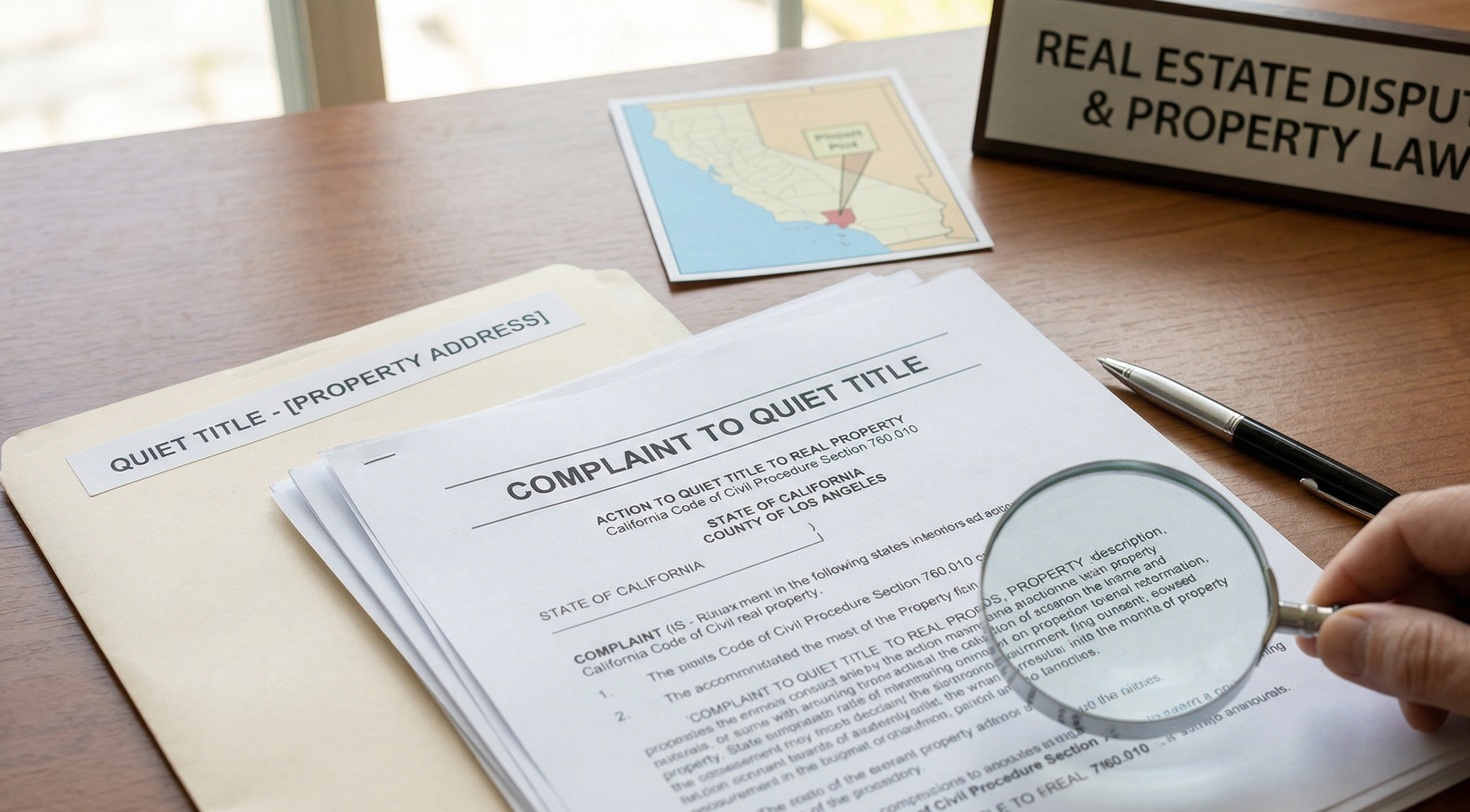
The Quiet Title Action Protocol
A quiet title action is a lawsuit to establish ownership of real property and “quiet” any competing claims. It’s commonly used to correct deed errors, remove wrongful liens or judgments, resolve boundary or encroachment disputes, address inheritance and trust conflicts, or clear title following adverse possession issues.
Our protocol for clearing title quiet title actions are highly technical; a single procedural foot-fault can void the final judgment. We adhere to a strict statutory process to ensure the result is binding.
1. Forensic Title Analysis We don’t just read the preliminary report. We conduct a “full title chain analysis” to identify every potential claimant—known or unknown—who must be named in the lawsuit to ensure the judgment is comprehensive.
2. Strategic Filing & Notice We prepare a verified complaint and immediately record a Lis Pendens (Notice of Pendency of Action) to prevent any new claims from attaching during the lawsuit. We then manage the complex process of serving all parties, including publication service for “unknown defendants.”
3. Judgment & Recordation If defendants fail to respond, we move quickly for default. If they contest, we litigate. The end goal is a certified Court Judgment recorded with the County Recorder, which acts as a “new deed” declaring you the sole, fee simple owner.
Quiet Title Actions in California
What Is a Quiet Title Action?
It’s a court action to establish ownership and eliminate adverse or uncertain claims. Quiet title actions are governed by California Code of Civil Procedure § 760.010 et seq. and are supported by evidence such as property surveys, recorded instruments, and possession history. Courts emphasize thorough documentation, including in Lynch v. Glass (1975) 44 Cal.App.3d 943.
Common Situations We Handle
Disputes over who owns the property; errors or ambiguities in deeds or legal descriptions; liens and judgments that shouldn’t be on title; boundary line disputes and encroachments; conflicting inheritance or trust claims; and clearing title after adverse possession claims.
The Quiet Title Process
Restoring Marketability & Insurability
Title companies are risk-averse and often refuse to insure properties with “clouded” histories. We obtain the specific judicial decrees required to satisfy underwriters, bridging the gap between an uninsurable property and a closed transaction.
Why Choose Us for Quiet Title Cases?
In the Bay Area—where property is among the most valuable in the country—title issues can bring sales, refinances, and construction to a halt. We clear clouds on title, defend against fraudulent or unfounded claims, and work with title companies and escrow to keep your deals moving.